Wincle
Primary
School

'Shine Like A Star' Philippians 2:15
Religious Studies
Psalm 119:12: ‘Blessed God, train me in your ways of wise living.’
Statement of Intent
At Wincle CE Primary School, we believe that Religious Education is a central subject within our curriculum because, as a church aided school, we believe that our Christian faith underpins and informs all aspects of our life and learning. High quality Religious Education (RE) is the key to enabling every child to flourish.
The Church of England's Statement of Entitlement details the expectations for religious education in Church of England schools and can be found here.
Quality RE has the potential, more than any other subject, to have the most powerful and lasting effect on the child’s heart and mind. It is a subject that combines academic rigour with the development of the character and spirit of the child. RE provides opportunities for spiritual development and personal reflection. On a quest to discover more about religion and world views, pupils will discover more about themselves. As RE develops children’s knowledge and understanding of the nature of religion and belief, it provokes challenging questions about meaning and purpose, truth and values, identity and belonging.
The Diocesan Board of Education makes the following recommendations to Governing Bodies: –
-
That the amount of time allocated to RE should be at least 5%. This is the minimum recommended in national guidelines. There will be occasions when RE takes a larger slice of the curriculum, reflecting the Church School’s greater commitment to the subject.
-
That in Voluntary Aided Church Schools, as is Wincle CE Primary School, the curriculum time for RE, Christianity should occupy 70% of the time. Therefore, 30% of RE curriculum time should be devoted to the study of the World Faiths and non-religious world views.
-
That as well as Christianity, pupils should study aspects of the practices and beliefs of Buddhism, Hinduism, Islam, Judaism and Sikhism, along with non-religious views such as Humanism.
-
The Governing Body should nominate a member to be responsible for oversight of the school’s RE provision and standards.
For more information, see https://www.churchofengland.org/sites/default/files/2019-02/re-statement-of-entitlement-for-church-schools.pdf
At Wincle School, we ensure that we meet these recommendations. We follow Questful RE, which is a scheme produced by the Blackburn Diocesan Board of Education. By embracing the explicit teaching of Christian concepts and God’s big salvation story, the content of this syllabus provides pupils with a deeper understanding of Christianity. In addition, pupils explore all major world faiths and discuss world views where appropriate. Whoever we are, wherever we live, whether we are a person of faith or not, we all have a view on the world. Nobody stands nowhere.
Pupils will experience, explore and encounter a wide range of creative and challenging multi-sensory activities that will help them to discover the answers to fundamental questions such as these:
-
Who am I and what does it mean to be me?
-
In what ways do/can I relate to others?
-
How/where can I encounter God?
-
How can I make a positive contribution to the world in which I live?
-
What values, attitudes, beliefs and behaviour are important to me?
-
What does it mean to have faith?
-
Who/what influences and inspires me?
Through an open investigative enquiry approach, the pupils will be given the sense of being on a quest of discovery. A key feature of the syllabus is the large number of questions included in each unit. The purpose of these questions is to give pupils opportunity to investigate, reflect, evaluate and make meaning. In doing so, they will discover more about themselves, their relationships with others, their relationship with the world around them and their relationship with God.
The curriculum content is a balance of the three essential disciplines of quality RE, Theology, Philosophy and Social Science. This means pupils will look at concepts through a theological lens, exploring what people of faith believe. Alongside this, pupils will explore questions and answers raised in relation to the lived reality and impact of religion and world views on people’s lives. They will also think like philosophers, and be equipped with the skills that will enable them to make sense of life’s experiences.
RE prepares children for citizenship in today’s diverse society. It enables them to develop sensitivity to, and respect for others. Through authentic encounters with living faith communities, pupils will develop diversity dexterity and be equipped with the ability to hold an informed conversation about religious beliefs and practices. The teaching of RE is both a huge responsibility and a privilege that must be recognised by those who teach it.
If you would like to see what your child will be learning in RE, please click here.
To view our RE policy, please click here.
Assessing in RE.
As part of their assessment, the pupils complete a learning map throughout their teaching. An example of a learning map can be found here.
We assess how well the pupils are making progress in the three disciplines by asking lots of different questions. The expected outcomes, standards and attainment can be found here.
Theology
As a field of enquiry, Theology is interested in stories, texts and other sources of authority, including influential people and traditions.
As pupils engage with learning in RE, they will be supported to have an increasingly complex understanding of theology as a field of enquiry and be able to use theological methods in increasingly complex ways so that they are ready for the next stage of learning. This will involve undertaking more sophisticated enquiries, asking more sophisticated questions and utilising methods in more sophisticated ways. This will look different for each pupil and isn’t linked to their age, phase or key stage.
The children will learn that stories, texts and sources of authority are carriers of meaning about beliefs and values; understanding this can
help us better understand someone’s worldview.
We will ask questions like:
*Where does this story come from?
*Is this story important to me? (If not, why not?)
* Is this story or text important to people? If so, to whom? Why is it important to them?
* Is this text a source of authority for anyone? If so, how is it used?
* Is its authority widely acknowledged (within and beyond the worldview)?
*Do some people question its authority? If so, why?
These stories, texts and sources of authority can contain ‘hidden meanings’ and are shaped by context (what sits behind) and we may ask questions like this.
* What is the story about?
*Who is this story about?
* What happens in this story?
* Who told this story? Who wrote this text?
* Why did they tell/write it – what difference did they think it would make?
*Why is this important? How can it help us understand the ‘hidden meaning’ of the story?
* What is this text / source of authority about?
*Who is it significant to? Why is it significant to them?
* How is this source of authority used? Has the way in which it is used or interpreted changed over time?
* Is it used differently in differently contexts and if so, why?
*How (if at all) does it relate to other sources of authority within this worldview?
These stories, texts and sources of authority are interpreted by readers who are influenced by their own context (what sits in front) and we may ask.
*What does this story tell me?
*Does everyone draw the same meaning from this text? If not, why not?
* How might context affect how someone understands the meaning of the text?
* What genre is this source of authority?
* How might this affect the way in which it is read/interpreted?
Social Science
As fields of enquiry, the Human/Social Sciences are interested in how people live, and how context affects this
As pupils engage with learning in RE, they will be supported to have increasingly complex understanding and use human and social scientific methods in increasingly complex ways so that they are ready for the next stage of learning. This will involve undertaking more sophisticated enquiries, asking more sophisticated questions and utilising methods in more sophisticated ways.
This will look different for each pupil and isn’t linked to their age, phase or key stage.
There is information that can tell us how people live, which helps us better understand their worldview, including objects, places, photographs, videos, surveys etc.
Questions we will ask in these discussions look like this:
What is this?
How is this used?
Who uses this?
Where might I find this?
When is this used?
What is happening here?
When is this? How do I know?
The way in which people live is affected by context, including time, place, culture, gender, etc; knowing about this can help us better understand their worldview. We may ask the following questions.
* Who does this? How do they do it? Why do they do it like this? Is this done the same way matter?
* Who uses this thing? Do different people use this same thing? How is this thing used?
* Does everyone use this thing in the same way? If not, why not?
* Is this thing used the same way today as it was in the past? Is this thing used the same way in one place as in another? Is this thing
used the same way by one person as another?
*What does this tell me about how context affects this thing?
When we are trying to understand a worldview, it is important to consider the origin of sources of information about how people live. To help pupils with this, we ask the following questions.
*Where is this information from?
*Does this alter the way I understand it?
* How else can we find out about this?
When we are trying to understand a worldview, it is important to consider how our own worldviews might shape the way we interpret
information about how people live. We ask..
*How might someone’s worldview affect the way in which they analyse this information?
*How might my worldview affect the way in which I analyse this information?
Philosophy
As a field of enquiry, Philosophy is interested in how people think/reason about themselves and the world around them.
As pupils engage with learning in RE, they will be supported to have increasingly complex understanding and use philosophical methods in increasingly complex ways so that they are ready for the next stage of learning. This will involve undertaking more sophisticated enquiries, asking more sophisticated questions and utilising methods in more sophisticated ways. This will look different for each pupil and isn’t linked to their age, phase or key stage.
Humans think or reason about themselves, others and the world around them, including their understanding of ‘good’ and ‘bad’ or ‘right’ and
‘wrong’; understanding how they do this can help us better understand their worldview. We may ask the following questions.
* What questions do I have about this thing?
* What do I think about this?
* What questions could I ask about this?
*What are good questions to ask? What are bad questions to ask? How do we know?
* How might asking questions help us to know more and to think more deeply?
* How does this way of thinking about tell us more about this person’s understanding what they understand ‘good’ (and ‘bad’) to of ‘right’ and ‘wrong’?
* What questions do I have about this?
* What questions do others ask about this?
* Do we all have the same questions?
* Why do I think this? Do I think the same thing as others? (If not, why not?)
* How does this person think about what it means to live a ‘good’ life? Why do they think this?
* What does this tell us about how might my/someone’s worldview impact on the way I/they think about this?
* Based on what we have learned about, how might this person justify that doing this is the right / wrong thing to do?
When we are trying to understand a worldview, it is important to consider whether our own and others’ processes of reasoning about human
beings, the world and morality/ethics are reliable. We may ask the following questions.
* How do we know what we know?
* What evidence do we / I have?
* Can I give a reason why I think what I think?
* Is this/your argument/position coherent/reliable?
* Does this make sense? How do we know?
*Is this a well-structured argument?
It is important to consider how different people (including ourselves) articulate their understanding of ‘validity’; this can help us better understand their worldview. We may ask the following questions.
*Is this a valid argument/position? How do you know?
*What evidence is there to support this?
*What different types of evidence might there be?
* Are all types of evidence equally valid? Why/why not?
As the pupils move through our scheme of work, they will progress in a number of skills. The progression of skills can be used here.
Visits to places of worship


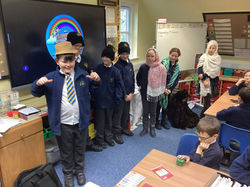
Walk Through The Bible Sessions for Jupiter Class - the focus on the Old Testament
 |  |  |
|---|---|---|
 |
 |  |  |
|---|---|---|
 |  |  |
Mars Class visited the church to learn what happens at a Christening.

Vicar Liz helps us develop our knowledge of Christian Art to support our learning in RE.
Sowing Roots often help consolidate our teaching and learning. Jupiter enjoyed an Easter workshop focusing on the Easter Story.
 |  |  |
|---|---|---|
 |
Celebrating Diwali

